Inside Wholesale Jamdani: Fabric Characteristics, Authenticity Guide & How to Order from Bengal

TL;DR
• Jamdani is a UNESCO Intangible Cultural Heritage weave from Bengal, woven using a supplementary weft technique that produces floating motifs directly on the loom. No printing. No embroidery. The pattern is the weave.
• Authenticity matters: the market has machine-made and jacquard imitations. This guide explains exactly how to distinguish authentic handloom Jamdani from substitutes.
• Thread count is the key spec: 40 to 60 count for entry commercial orders; 84 to 100 count for luxury and heritage pieces. Count drives price, lead time, and end-use.
• Available shades at Anuprerna: white, natural/off-white, and navy are the core Jamdani colourways, with geometric, stripe, check, and floral motif variants.
• Lead time is longer than plain fabric: a single metre of fine Jamdani can take a skilled weaver several days. Plan your sourcing timeline accordingly.
• Buyers close to purchase: order a SwatchKit first. Jamdani must be held and evaluated in person before bulk commitment.
There is a category of fabric that sits in a different commercial conversation from commodity cotton or even premium silk. Jamdani is one of those fabrics. It is not simply a patterned textile. It is a weaving tradition over 2,000 years old, originating in the Bengal region, patronised by Mughal emperors, declared a UNESCO Intangible Cultural Heritage in 2013, and now experiencing a carefully managed revival through artisan-led production in West Bengal and Bangladesh.
For wholesale buyers at sustainable fashion brands and heritage textile labels, Jamdani is both a product and a provenance claim. It is the kind of fabric that sells a collection before the garment is cut, because the story it carries is immediately legible to conscious consumers.
But sourcing authentic Jamdani at wholesale requires specific knowledge: of the weave structure, of what distinguishes a genuine supplementary weft Jamdani from a jacquard or printed imitation, of how thread count determines price and end-use, and of how to build a reliable supply relationship with Bengal artisan weavers.
This guide covers all of it.
Market context: The global handloom products market is projected to grow from USD 8.95 billion in 2025 to USD 16.62 billion by 2032, at a CAGR of 9.24% (Save Handloom Foundation / Fortune Business Insights). India's handloom sector employs around 3.52 million people directly and indirectly, with 72% of weavers being women (IBEF Handloom Industry Report). Within this, West Bengal's Jamdani weaving clusters, centred around Phulia in Nadia district, represent one of the most technically demanding and culturally significant segments of the entire sector.
What Jamdani Actually Is: A Weaver's Definition for Wholesale Buyers
What Defines Authentic Jamdani Fabric
The confusion around Jamdani in the wholesale market stems from a fundamental misunderstanding of what the word means. Many suppliers use 'Jamdani' to describe any cotton fabric with a woven or printed floral or geometric pattern. This is incorrect, and for buyers building an authenticity claim, the distinction matters.
Authentic Jamdani is defined by its weave construction, not by its pattern. Specifically:
- Supplementary weft technique: Jamdani is woven on a pit loom using two sets of weft threads. The first, structural weft creates the base fabric. The second, supplementary weft, interlaces with the warp at selected points to build the motif, thread by thread, by hand. The result is a pattern that appears to float on the surface of the fabric.
- No printing, no embroidery, no jacquard: the pattern in authentic Jamdani is created entirely by the weaving process. It is not applied after weaving, and it is not produced by a programmed jacquard mechanism. Two weavers typically work side by side at the loom, manually placing each supplementary weft thread.
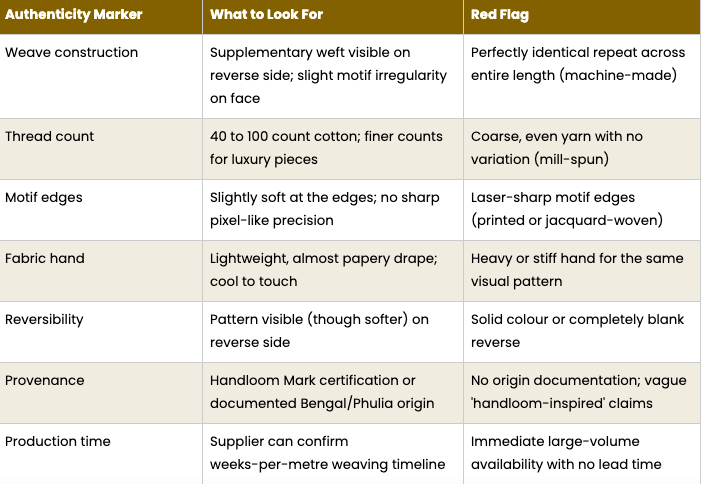
- Reversible pattern: because the pattern is woven in, it is visible on both sides of the fabric, though slightly softer on the reverse. This reversibility is one of the clearest authenticity markers.
- Inherent irregularity: every motif in a genuine Jamdani piece has slight variation from the theoretical repeat. This is not a defect. It is the signature of handwork, and experienced buyers know to look for it.
Historical note: The word 'Jamdani' is Persian in origin, meaning 'flower vase', reflecting the Mughal court's influence on the textile's iconography. The weave tradition is believed to be a fusion of ancient Bengali cloth-making techniques, possibly 2,000 years old, with muslin production developed by Bengali Muslim weavers from the 14th century. In 2013, UNESCO declared the traditional art of Jamdani weaving an Intangible Cultural Heritage of Humanity, recognising both its cultural significance and its vulnerability as a living craft.
How to Identify Authentic Jamdani: A Wholesale Buyer's Checklist
How to Verify Genuine Handwoven Jamdani
The wholesale market for Jamdani includes a significant volume of machine-made jacquard imitations, screen-printed cotton fabrics sold as Jamdani, and hybrid pieces that use a power loom base with hand-applied supplementary weft. For buyers making an authenticity claim, understanding how to distinguish genuine handloom Jamdani is not optional. It is a sourcing fundamental.
At Anuprerna, all Jamdani fabric is woven by skilled Bengal artisan weavers in the traditional supplementary weft technique on pit looms. Buyers can request weaving documentation, artisan details, and production photographs as part of the order process.
Jamdani Weave Specifications: What Wholesale Buyers Need to Confirm
Jamdani Fabric Specifications: Count, GSM and Use
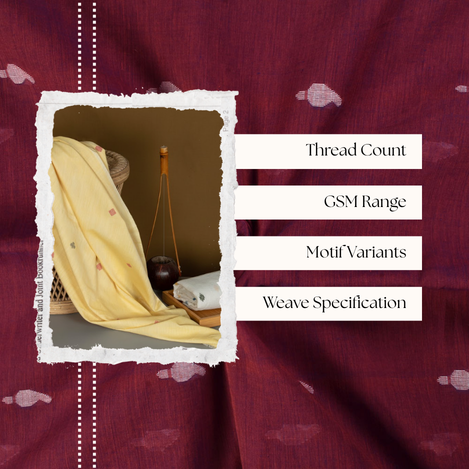
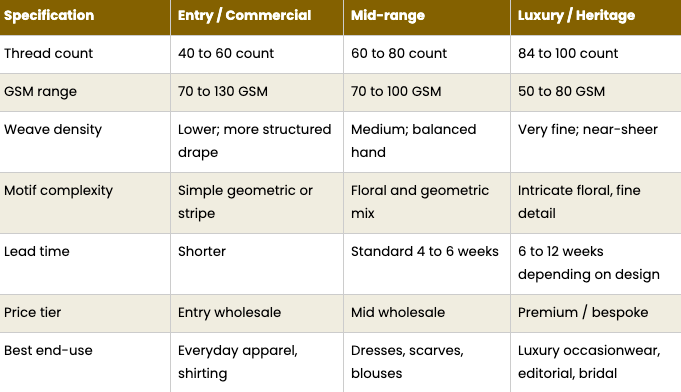
Once authenticity is established, the next buying decision is technical specification. The two most important variables for wholesale Jamdani buyers are thread count and motif complexity, because together they determine GSM, drape, lead time, and price.
How to Choose the Right Jamdani Based on Weight, Fineness and Design Direction
Jamdani Specifications Decoded: Thread Count, GSM and Motif Selection
Thread Count
Thread count in Jamdani is measured in count, not threads per inch as in plain weave fabrics. This is because Jamdani uses two weft systems, and the count refers to the fineness of the cotton yarn used.
- 40 to 60 count: entry-level and commercial Jamdani. More body, slightly heavier hand, faster weaving time. Suitable for everyday apparel, scarves, and home textile applications.
- 60 to 80 count: mid-range. The standard for most contemporary sustainable fashion collections. Balanced between handle and transparency. Good drape for dresses and blouses.
- 84 to 100 count: luxury and heritage Jamdani. Near-sheer, papery lightness, complex motifs. Weaving a single metre can take a skilled artisan several days. Reserved for luxury occasionwear, editorial, and bespoke collections.
GSM Range
GSM in Jamdani is lower than in plain cotton of the same intended application, because the base fabric is designed to be fine and light. Expect:
- 50 to 80 GSM for fine and luxury count Jamdani
- 60 to 100 GSM for mid to entry commercial count Jamdani
For buyers accustomed to specifying plain cotton at 140 to 200 GSM, this requires a recalibration. Jamdani's strength is its woven structure, not its mass.
Motif Variants at Anuprerna
Anuprerna's Jamdani range covers four core motif families, each suited to different design directions:
- Geometric: angular, repeating patterns. Strong in contemporary sustainable fashion. Reads as modern while retaining artisan authenticity. Available in white, natural, and navy colourways.
- Stripe: woven stripe in single or multicolour supplementary weft. Versatile for both apparel and accessories. Popular for shirt and trouser fabric in menswear and genderless collections.
- Check / Guti: small dot or check pattern, one of the most traditional Jamdani motif families. Clean, minimal, and well-suited to contemporary minimalist brands.
- Floral / Butah: the classic Jamdani motif vocabulary: floating flowers, vines, and medallions. Higher weaving complexity; longer lead time; strongest heritage narrative. Best for luxury and occasionwear collections.
Full Weave Specification Reference
Jamdani Colourways at Anuprerna: White, Natural and Navy
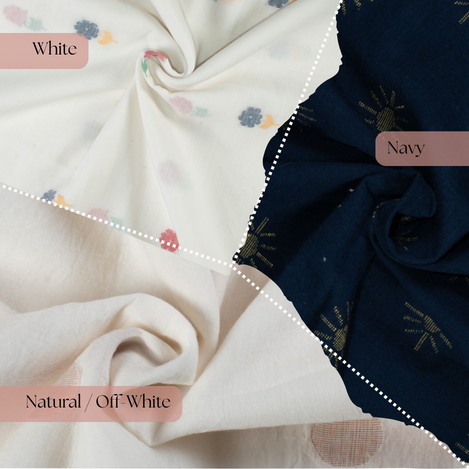
Choosing the Right Shade for Aesthetic Direction, Performance and End Use
Jamdani Colourways Explained: White, Natural and Navy
White Jamdani
White Jamdani is the purest expression of the Jamdani tradition. The supplementary weft motif is visible as a subtle, slightly raised texture against the white base. In direct light, the pattern catches the surface and becomes fully legible; in diffused light, it reads as a tonal, near-monochrome texture.
- Best for: bridal collections, minimalist luxury, editorial and press looks, resort wear
- Dye: undyed or azo-free whitened base; natural cotton colour for supplementary weft
- Lead time: standard for geometric and check variants; longer for floral
Natural / Off-White Jamdani
Natural Jamdani retains the warm cream tone of unbleached cotton in both base and supplementary weft. The result is a softer, more tactile visual quality than white, with the characteristic slub and warmth of unprocessed fibre.
- Best for: slow fashion collections, natural palette brands, gender-neutral capsules, brands building a raw-material provenance story
- Dye: undyed throughout
- Lead time: shortest in the Jamdani range, as no dyeing is required
Navy Jamdani
Navy Jamdani is the most commercially striking colourway. The deep blue base fabric with white or lighter supplementary weft motifs creates a high-contrast, visually arresting fabric that commands attention in product photography and editorial contexts. On Jamdani, navy achieves a richness that plain navy cotton cannot replicate.
- Dye method: azo-free synthetic navy (for consistent depth and colorfastness) or natural vat-dyed navy for brands requiring natural dye provenance
- Colorfastness: Grade 5 to 6 with azo-free synthetic; Grade 3 to 4 with natural dye
- Best for: statement collection pieces, denim-alternative capsules, Japanese-influenced design direction, artisan-forward brand positioning
Why Wholesale Buyers Source Jamdani from Anuprerna
Why Choose Anuprerna for Jamdani Wholesale
Sourcing authentic Jamdani at wholesale requires more than finding a supplier who uses the name correctly. It requires a partner with direct weaver relationships, documented production processes, and the operational infrastructure to handle B2B orders with the consistency that fashion and heritage brands require.
- Direct Bengal artisan partnerships: Anuprerna works with 300 or more skilled handloom weavers in West Bengal's traditional weaving clusters. Jamdani buyers are purchasing fabric woven by identified artisans, not through an opaque supply chain.
- Verified authenticity: all Jamdani fabric at Anuprerna is produced using the supplementary weft technique on traditional pit looms. Weaving documentation, artisan details, and production photographs are available on request.
- Low MOQ: Anuprerna's order structure is designed for sustainable brands and heritage labels building capsule collections, not only for volume buyers. Minimum order quantities are accessible for labels at different scales.
- ArtisanFlow platform: Anuprerna's proprietary B2B supply chain tool gives wholesale partners real-time visibility into production stages. For a weave with Jamdani's lead time, production visibility is not a luxury: it is a planning essential.
- GOTS-certified, azo-free dyes: standard for all dyed Jamdani colourways.
- SwatchKit ordering: Jamdani cannot be adequately evaluated on a screen. The weight, drape, motif clarity, and fabric hand must be experienced in person. Anuprerna's SwatchKit process is the recommended starting point for all new Jamdani wholesale enquiries.
The scale of India's artisan textile sector gives this sourcing relationship commercial context: India's handicrafts exports reached USD 3.89 billion in FY25 (IBEF / EPCH), with hand-printed textiles and scarves among the leading categories. For sustainable fashion brands building a supply chain story around verified artisan production, Jamdani from Bengal positions the brand at the credible premium end of this market.
How to Order Jamdani at Wholesale from Anuprerna
Step-by-Step Jamdani Wholesale Ordering Process
The recommended sequence for new Jamdani wholesale partners:
- Order a SwatchKit: Request Jamdani swatches in your target colourways and motif families. Evaluate weave clarity, fabric hand, motif definition, and drape. Confirm thread count range against your end-use requirements.
- Specify thread count and motif: Confirm whether you need entry commercial count (40 to 60), mid-range (60 to 80), or luxury count (84 to 100). Confirm motif family: geometric, stripe, check, or floral. Motif complexity is the largest driver of lead time and price.
- Specify colourway and dye preference: White, natural, or navy. For navy, confirm whether you need azo-free synthetic or natural vat dye. This affects lead time, colorfastness, and available certifications.
- Confirm width and quantity: Standard Jamdani fabric widths apply. Confirm your pattern-cutting requirements before sample yardage to avoid wastage in production.
- Request sample yardage: Cut and construct a test garment. Evaluate the supplementary weft behaviour under tension during sewing. Wash test the fabric under your production conditions.
- Place wholesale order: Once sample is approved, confirm all specifications and delivery schedule with the Anuprerna wholesale team. For fine and luxury count Jamdani, build the full lead time into your production calendar.
Ready to Source Authentic Bengal Jamdani at Wholesale?
Source Jamdani That Holds Up Beyond the Story
Anuprerna's Jamdani SwatchKit gives you authenticated, artisan-woven fabric samples to evaluate in your studio before any bulk commitment. Hold the fabric. Check the weave. Confirm the motif. Then order with confidence.
frequently asked questions
How do I confirm that the Jamdani I am ordering is genuinely handwoven and not machine-made?
Request weaving documentation from your supplier before committing to bulk. At Anuprerna, buyers can receive artisan details, production photographs, and weaving records for their Jamdani orders. Physical evaluation of a swatch is also essential: authentic supplementary weft Jamdani will show slight motif irregularity, a reversible pattern visible on the underside, and a lightweight, papery hand that machine constructions cannot replicate.
What is the typical lead time for Jamdani wholesale orders?
Lead time for Jamdani is longer than for plain handloom cotton and depends heavily on thread count and motif complexity. Entry count geometric or check Jamdani typically requires 4 to 6 weeks. Mid-range with floral motifs typically requires 6 to 8 weeks. Fine count luxury Jamdani with complex floral patterns can require 10 to 12 weeks or more. The Anuprerna team will provide a confirmed lead time at point of order based on current artisan capacity and design specification.
Can I order a custom motif or a bespoke colour for my collection?
Custom motif development is available for established wholesale partners. This involves working with the weaver team to translate a design brief into a supplementary weft pattern. The process requires a minimum commitment and a sample approval stage before full production. Custom colourways beyond white, natural, and navy are also available subject to minimum quantities and dye compatibility with the Jamdani weave structure. Contact the wholesale team to discuss your brief.
Is Jamdani fabric suitable for machine sewing in commercial production?
Yes, with appropriate machine settings. The fine count variants require careful tension calibration and a fine needle to avoid distorting the supplementary weft threads. Entry and mid count Jamdani sews well under standard commercial conditions. Anuprerna recommends requesting sample yardage for production testing before bulk commitment, particularly for fine count pieces. The team can advise on recommended construction techniques for each thread count.
What certifications are available for Jamdani wholesale orders?
Anuprerna's standard dyed Jamdani uses GOTS-certified, azo-free dyes. Natural vat-dyed navy orders can be accompanied by dye source documentation. For Handloom Mark certification, which validates authentic handloom origin, please enquire directly with the team. Certification scope is confirmed at time of order based on the specific weave and dye specifications required.
Can I source Jamdani alongside other Anuprerna fabrics in a single wholesale order?
Yes. Anuprerna's range includes Jamdani, plain khadi, handloom cotton, and mulberry silk, all from the same Bengal artisan network. Consolidating multiple fabric types into a single order is possible and is a practical approach for brands building a full collection from a single ethical supplier. Contact the team to discuss a multi-fabric wholesale enquiry.
More Blogs
designing with honeycomb material: best uses for waffle weave textiles
raschel knit vs warp knit: understanding the differences
mastering screen printing on khadi: challenges, best practices, and sustainable solutions
the art of hand screen printing: a step-by-step guide to artisanal fabric printing
raschel knit fabric explained: how it’s made, where it’s used, and how it compares
can one fabric feel luxurious and sustainable? meet the silk-bamboo blend